
- Entertainment
- Style
- Lifestyle
- Food & Drinks
- Tech & Auto
- Culture

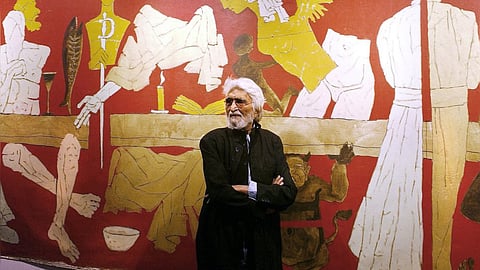
Before he was an icon, M. F. Husain was a billboard painter in Bombay. At night, perched barefoot on bamboo scaffolding, he brushed Bollywood stars larger than life onto hoardings, using leftover paint on discarded scraps when he could not afford canvas. That resourcefulness shaped him. His strokes were wide, his figures monumental, his colours unafraid of being loud. Horses galloped across his canvases, goddesses stood tall, and human stories unfolded with the scale of myth. Even when he became India’s most celebrated modernist, Husain never stopped walking barefoot—the painter who wanted to feel the earth beneath him.
Fourteen years after his death, the world is preparing to give him a kind of permanence he never found in life. On November 28, in Doha, Qatar will open the Lawh Wa Qalam: M. F. Husain Museum—the first and largest institution devoted entirely to his work. For a man who ended his days in exile, unable to return to India after controversy turned into hostility, the museum is more than a cultural landmark. It is a reconciliation written in blue concrete and white columns, a homecoming not in the land of his birth but in the land that gave him refuge.
Few museums carry the imprint of the artist they honour in such a literal way. In 2008, Husain sketched what he imagined an archive of his life’s work might look like: a geometric, indigo structure punctuated with apertures resembling Arabic script, and a tall white cylinder rising like a minaret. Architect Martand Khosla has turned that drawing into a building that now stands in Doha’s Education City. It feels less like a museum imposed on an artist, and more like the artist’s own dream finally built in brick and glass.
Inside its 3,000 square metres, visitors will encounter not only Husain’s paintings but also the full breadth of his creative universe: his forays into cinema, his tapestries and photography, his poetry and installations. Among the most anticipated is Seeroo fi al ardh, his vast final work—an immersive installation that charts humanity’s progress, commissioned by Sheikha Moza bint Nasser, one of his most ardent patrons and the force behind the museum itself. Alongside it will hang more than 35 canvases inspired by Arab civilisation, completed during his last years in Qatar. Together, they form a body of work that bridges the artist’s Indian origins with his Gulf exile, myth with modernity, memory with reinvention.
Husain’s story is inseparable from that of independent India. As a founding member of the Bombay Progressive Artists’ Group in the late 1940s, he helped drag Indian painting into the modern era. His canvases drew on folk traditions, mythology, and popular culture, but refracted them through a lens of experimentation and bold, global modernism. He painted Hindu deities with the same reverence as he painted Islamic motifs, a Muslim artist embodying the plural spirit of the republic.
But the India that once embraced him eventually rejected him. By the 1990s, his depictions of nude goddesses and his later painting of Bharat Mata as a naked woman ignited protests, lawsuits, and threats. Husain left in 2006, first to Dubai and then to Qatar. In 2010, the Qatari royal family granted him citizenship—a symbolic gesture of belonging that his own country denied. He died in London the following year, at 95, without ever returning to India.
Husain’s canvases are reminders of an India that once saw modernism as an act of freedom, before censorship and sectarianism closed in. In that sense, the museum is not just about Husain, but also about what was lost when he left.
With time, his relevance has only deepened. Earlier this year, a long-lost Husain mural from 1954, Gram Yatra, sold for $13.8 million at Christie’s, setting a record for modern Indian art. Collectors and curators are finally acknowledging what was always true: Husain was not derivative of European modernism, but parallel to it—an artist whose work spoke in an Indian idiom yet resonated globally. In a cultural moment where artificial intelligence churns out uncanny imitations of human creativity, Husain’s canvases barefoot years, the exile, the cinema, the scandal, the myth.
For India, the museum may sting—a reminder of an artist it pushed away. For Qatar, it is a statement of cultural ambition, but also of loyalty to a man who found his last decade of purpose on its soil. For the rest of the world, it is a chance to encounter Husain not as controversy, not as auction headline, but as he always wanted to be seen: a storyteller who painted civilisation itself as cinema, myth as poetry, life as colour.